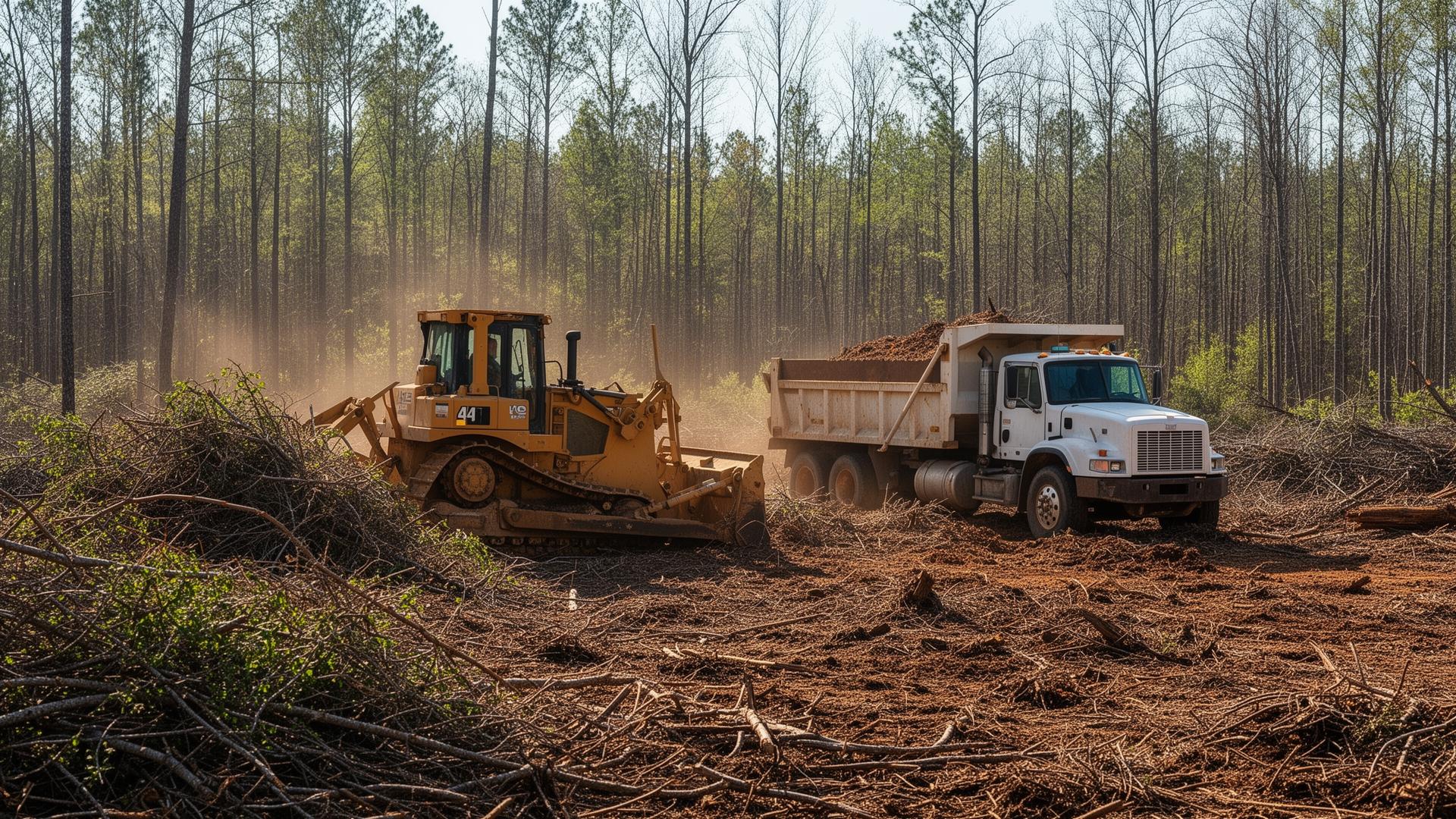

A driveway culvert installed by a contractor generally runs $1,000 to $9,000, with national averages landing around $4,500. A straight pipe swap in an existing ditch sits at the bottom. A deep crossing with concrete headwalls and a rebuilt driveway apron sits at the top.
But before you price anything, there is one thing worth knowing that almost no cost guide will tell you: in West Tennessee you do not get to choose your pipe size. The county does. Shelby County Engineering sets the minimum diameter. Tipton County sets it on the permit form. Put in the wrong pipe and Tipton County's own regulations say it comes out and goes back in at your expense.
That one fact changes the order of operations on this job, and it is why a $10 permit is the cheapest insurance in this entire article. Here is what the work actually costs around Memphis, who you have to ask first, and how to keep from paying for the same crossing twice.
What a Driveway Culvert Costs to Install
| Scope of work | What it involves | Planning range |
|---|---|---|
| Straight replacement in an existing ditch line | Pull the failed pipe, set new pipe to grade, bed and compact, restore gravel surface | $1,200 - $2,800 |
| New crossing on an open roadside ditch | Cut and shape the ditch, set pipe, flared end sections, gravel apron over the top | $2,500 - $5,500 |
| Deep or wide crossing, larger diameter pipe | Heavier excavation, stone bedding, concrete end walls, longer pipe run for a wide drive | $5,000 - $9,000+ |
| Paved surface over the crossing | Concrete or asphalt driveway apron rebuilt on top of the finished culvert | Add $1,500 - $4,000 |
Treat these as planning bands, not quotes. They are a breakdown of the published national installed range and how those jobs actually separate in the field. Your number depends on depth, diameter, pipe length, what the ends get, and whether a hard surface has to be rebuilt afterward.
Worth noticing: the pipe is rarely the expensive part. Retail pricing on a 24-inch by 20-foot section runs roughly $700 for plastic and around $800 for aluminum or galvanized steel. On a $4,000 job, the pipe is a fifth of it. The dig, the bedding, the compaction, and the surface restoration are the rest, and that is why the quotes you collect will vary more than the materials ever could.
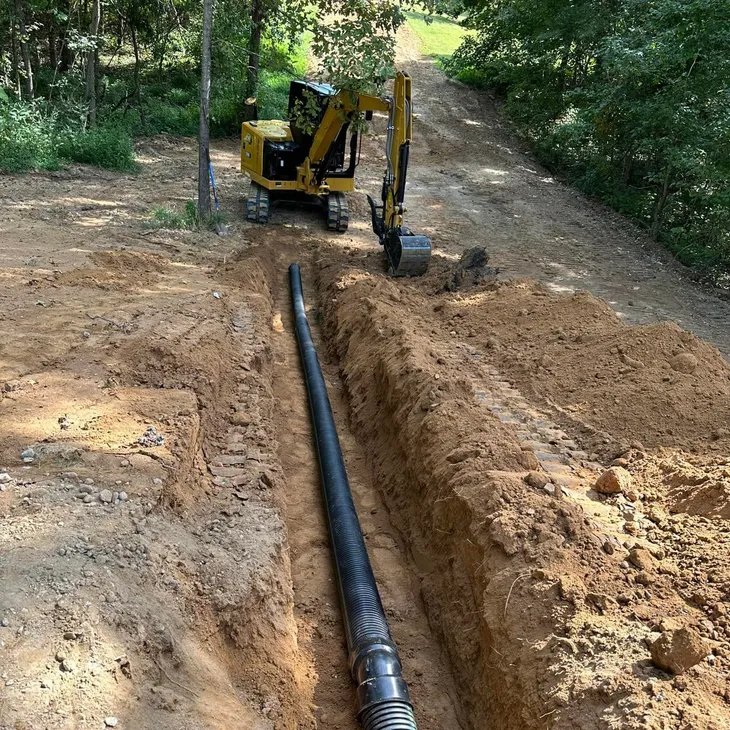
You Do Not Pick the Pipe Size. The County Does.
Search this topic and you will read that driveway culverts are "typically 10 or 12 inches," or "usually 12 to 15 inches." Those numbers are not wrong as national generalizations. They are also not the number you are allowed to install.
A driveway culvert sits in the public right-of-way, which means the road authority that maintains that road has a say in what goes under it. Around here, that authority is specific, local, and reachable by phone before you spend a dollar.
Shelby County
A property owner has to obtain a Driveway Permit before building a driveway connection from a public roadway. It is issued by Shelby County Engineering, 6463 Haley Road, Memphis, and the residential fee is $10. Where the driveway crosses a drainage ditch, the County Engineering Department determines the minimum size of the pipe to be used. That is their language, not ours. Call Engineering at (901) 222-7705 and ask for the specification before ordering pipe.
Ten dollars and a phone call. There is no version of this job where skipping that step saves you money.
Tipton County
Tipton County Public Works issues a driveway culvert and storm drain permit, and the form itself has blanks the county fills in: required minimum culvert size and required minimum pipe length. The work has to conform to the Tipton County Subdivision Regulations for culverts and storm drains on county right-of-way.
And then the sentence that should decide how you approach this job: any culvert or storm drain that does not meet county specifications will be removed and reinstalled or replaced at the owner's expense.
That is the whole argument for permitting first. A culvert installed a size too small is not a code violation you negotiate later. It is a second excavation, a second pipe, and a second driveway repair, paid for by whoever installed the first one.
On a State Highway
If your drive connects to a state route rather than a county road, TDOT governs it, and the numbers change. A state highway entrance permit is required before construction, and TDOT's driveway manual specifies that drainage pipes be a minimum of eighteen inches in diameter - noticeably larger than the 10 to 12 inches the national guides suggest. Residential applicants are directed to their local TDOT District Office, and residential driveways are exempt from the bond requirement that commercial entrances carry.
One detail people find surprising: once a pipe is properly installed under a TDOT permit, it becomes department property and TDOT maintains it. That is a meaningful difference from a county ditch pipe, where upkeep stays with the property owner.
Inside City Limits
If the property sits inside an incorporated city - Memphis, Millington, Atoka, Munford, Covington - the city, not the county, handles the permit for its own streets. Requirements and fees vary by city, so confirm with that city's permit office before you schedule work. The principle does not change: somebody other than you signs off on the diameter.
What Actually Moves the Price
Diameter and length. Both are set by the crossing, not by preference. A wide driveway needs a longer pipe, and a longer pipe needs more trench, more bedding stone, and more backfill. Length grows faster than people expect once you account for the slopes on each end.
Depth and ditch shape. A shallow roadside swale is a short day. A deep, steep ditch means a bigger excavator, more spoil to deal with, and sometimes shoring. Depth is the single biggest driver of machine time on these jobs.
What the ends get. Bare pipe ends erode. Flared end sections are the economical fix; poured headwalls cost more and last longer, and some jurisdictions require them. This line item is where two bids on the same crossing often diverge.
Our soil. Memphis-area ground is loess - deep, silty, wind-deposited, and less than 5% sand. It trenches beautifully when it is dry and turns greasy when it is saturated. It also does not forgive poor compaction. A culvert backfilled carelessly in loess settles, and the dip that shows up in your driveway six months later is the expensive kind of callback. Proper bedding and compaction in lifts is not an upsell on this job; it is the job.
Surface restoration. Gravel is straightforward. Concrete or asphalt over the crossing is a separate trade and a separate cost, and it is the most common reason a culvert quote comes in higher than someone expected.
Concrete, Metal, or Plastic
| Material | Strengths | Watch out for |
|---|---|---|
| Corrugated plastic (HDPE) | Light, quick to set, no corrosion, lowest material cost | Needs correct bedding and cover depth to carry loads; crushes if installed shallow under heavy traffic |
| Corrugated metal | Strong, handles shallow cover better, long lengths available | Corrodes over decades, especially where water stands in the invert year-round |
| Concrete | Longest service life, best under heavy or commercial traffic | Heavy enough to need equipment to place, highest installed cost |
For most residential drives in Shelby and Tipton County the practical answer is plastic or metal, sized by the county and bedded properly. Concrete earns its cost on commercial entrances and on drives that see loaded trucks. Check your permit first either way - some jurisdictions specify allowable materials along with the diameter.
Repair, Clean, or Replace
Not every failing culvert needs replacing, and an honest contractor will tell you which one you have.
Clean it when water backs up after a hard rain but the pipe itself is sound. Silt, leaves, and gravel washed in from the drive are the usual culprits, and in West Tennessee a pipe that has not been cleaned out in several years will be carrying a sediment load. This is routine maintenance, not a project.
Repair it when the ends have eroded back or a flared end section has washed out but the barrel is intact. End treatment is often fixable on its own.
Replace it when the pipe is crushed, rusted through at the invert, separated at a joint, or when the driveway above it has started to dip or sinkhole. That last one is the signal people wait too long on. A depression forming over a culvert means soil is migrating into the pipe through a failure, and the hole under your driveway is bigger than the dip you can see.
Replacement is also the moment to confirm the size with the county. The pipe that has been there for thirty years is not automatically the pipe you are permitted to put back.
The Best Time of Year for This Work
Late summer through fall is the window, and the reasoning is the same as every other dirt job in this region. Ditches are dry, so the trench stays open and the pipe can be set to grade without fighting standing water. Loess compacts properly when it is not saturated. And the work gets finished before the wet season rather than during it.
West Tennessee gets its heaviest, most persistent rain from late winter into spring. A crossing that is undersized or silted up will announce itself in February, which is precisely the worst month to be digging it out. If your culvert struggled last spring, this fall is the time to deal with it.
There is a sequencing point here too. If a culvert is going in as part of a new drive, get the grading and the gravel planned around it rather than after it. And if water is already cutting at the ditch banks, erosion control belongs in the same conversation - a new pipe discharging into an unstable ditch just moves the problem downstream.
What We'd Need to See to Quote It
Nobody can price a culvert crossing from a table, and that includes us. What sets your number is the depth of the ditch, the width of the drive, the diameter the county requires, what the ends get, and whether a hard surface has to go back on top. All of that takes a look at the actual crossing.
Modern Shovel is based in Millington and owned by Austin Scott. We own our equipment, we are fully insured, and we hold a 4.9-star rating across 30+ Google reviews. We handle culvert installation for residential drives and commercial entrances, and we deal with the county on sizing and permitting as a normal part of the job rather than leaving it to the homeowner.
If the real issue turns out to be water in the wrong place generally rather than the crossing itself, we will say so - sometimes the fix is drainage installation or regrading rather than a bigger pipe, and that is a cheaper conversation to have before the work than after.
Call (901) 479-0236 or request a free estimate. We cover Memphis, Millington, Bartlett, Arlington, Collierville, Germantown and Lakeland in Shelby County, Atoka, Munford, Brighton and Covington in Tipton County, and out into Fayette, Lauderdale and Haywood - see our full service area.
Frequently Asked Questions
How much does it cost to install a driveway culvert?
Professionally installed, roughly $1,000 to $9,000, with national averages around $4,500. A straight pipe swap in an existing ditch typically lands between $1,200 and $2,800, a new crossing on an open ditch between $2,500 and $5,500, and deeper or wider crossings with concrete end walls higher than that. Rebuilding a concrete or asphalt apron over the top adds to it.
What size culvert pipe do I need for my driveway?
That is not your decision to make in West Tennessee. Shelby County Engineering determines the minimum pipe size where a driveway crosses a ditch, and Tipton County fills the required minimum size and length in on the permit form. On a state route, TDOT requires drainage pipe of at least 18 inches. Confirm the specification before you buy pipe.
Do I need a permit to install a driveway culvert in Tennessee?
Yes. Shelby County requires a Driveway Permit through County Engineering before a driveway connects to a public roadway, and the residential fee is $10. Tipton County issues its own driveway culvert and storm drain permit through Public Works. A connection to a state highway requires a TDOT entrance permit. Inside city limits, the city issues the permit.
What happens if I install a culvert without a permit?
In Tipton County the regulations are explicit: a culvert that does not meet county specifications will be removed and reinstalled or replaced at the owner's expense. So the risk is not a fine, it is paying for the same crossing twice, including a second driveway repair. A permit that costs $10 in Shelby County prevents a four-figure mistake.
How do I know if my driveway culvert needs replacing?
Water backing up after rain usually means the pipe is silted and needs cleaning, not replacing. Replace it when the barrel is crushed, rusted through, or separated at a joint - or when the driveway above it starts to dip. A depression over a culvert means soil is washing into the pipe through a failure, and the void underneath is larger than what shows on the surface.
Get a Free Culvert Estimate
We'll look at the crossing, confirm the size the county requires, and put the pipe, the ends, and the surface restoration in writing as separate lines. Call (901) 479-0236 or request a quote online.
Sources: Shelby County, TN Driveway Permit, Shelby County Engineering; Tipton County, TN Public Works driveway culvert and storm drain permit and Tipton County Subdivision Regulations; Tennessee Department of Transportation, Manual for Constructing Driveway Entrances on State Highways (2015 edition), sections 2.1, 2.2, 2.5, 6.2 and 8.1; Angi, driveway culvert replacement cost data; USDA Official Series Description, MEMPHIS soil series. Permit fees and specifications change - confirm current requirements with the issuing office before work begins.