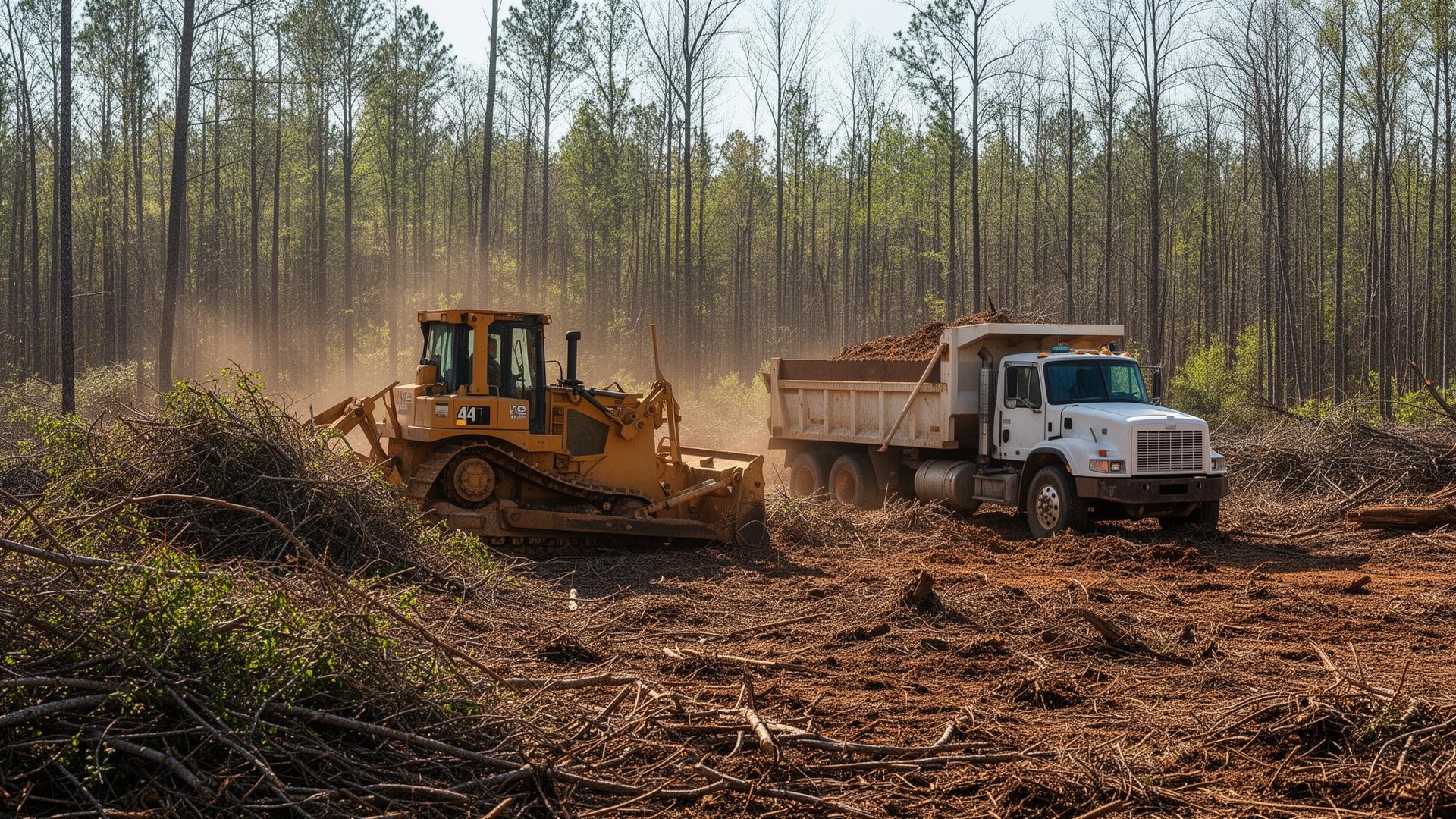

Start by timing it. Water that is gone within 24 hours of the rain stopping is a surface problem, and surface problems are fixed by moving dirt. Water that sits for two or three days, or comes back when it has not rained in a week, is almost never a surface problem, and regrading it will not help.
That second case is the common one around Memphis, and there is a specific reason for it. Most of the upland soils in Shelby and Tipton County have a fragipan: a dense, brittle layer of compacted silt somewhere between 14 and 36 inches down that water moves through very slowly. Rain soaks in, reaches that layer, stops, and backs up toward the surface. The soil is not saturated from the bottom up. It is saturated from a ceiling you cannot see.
This matters because it decides which fix works. A trench full of gravel dug into a bowl in fragipan soil is a bathtub with a lid on it. Here is how to tell which problem you actually have, before anyone quotes you a number.
Time It First, Then Look
Before you call anyone, go out after the next real rain and watch the spot for three days. What you see sorts the problem into one of three buckets, and each one points at a different fix.
| What you see | What it usually means |
|---|---|
| Puddle gone within 24 hours, same spot every time | A low spot or a reversed grade. Surface water is collecting faster than it can run off. |
| Water stands 2 to 4 days, ground stays spongy for a week | Water perched on a restrictive layer, usually a fragipan. The soil below is not taking it. |
| Wet with no recent rain, or a seep partway down a slope | Water moving sideways above the fragipan and surfacing where the slope cuts into it. |
| Only wet near the house, worst at a corner | Roof water. Gutters and downspouts, not the yard. |
| Was fine for years, started after work was done nearby | Compaction or a changed grade. Something upstream of you moved. |
Then dig one hole. A post hole digger or a shovel is enough. Go down two feet in the wet area and look at what comes out. Loose brown silt all the way down is one answer. Hitting something at 18 or 24 inches that is noticeably harder, that the shovel bounces off, and that comes up in dense angular chunks rather than crumbs, is a very different answer. That second one is the layer this whole article is about.
The Layer Under Most Yards Around Memphis
West Tennessee sits under a deep cap of windblown silt called loess. Over thousands of years, part of that silt compacted into a fragipan, and the soil surveys for this area are built around which soils have one and which do not.
Three names cover most of the ground an excavator sees here:
- Loring. Moderately well drained with a fragipan. Depth to the fragipan ranges from 14 to 35 inches. The reference profile for the entire Loring series was described in Shelby County, Tennessee, just north of Pleasant Ridge Road near Bolton School. The textbook example of this soil is in our service area.
- Grenada. Also moderately well drained over a fragipan, generally 18 to 36 inches down, with an eroded version that can put the pan as shallow as 12 inches. The official description says it plainly: the fragipan perches water during wet seasons in late winter and early in spring, and the soil is saturated above the pan in those months in a normal year.
- Memphis. Well drained, and the important part, no fragipan. Mostly on hillsides. If your lot is Memphis silt loam and it is still holding water, the cause is above ground, not below it.
There are also the low spots. Henry soils are poorly drained and sit in drainageways and depressions, and Calloway soils are somewhat poorly drained in lower positions in the landscape. If a subdivision was laid out across one of those, some of the lots were wet before a single house went up.
Look up your own lot in about five minutes
You do not have to take anyone's word for this. The USDA keeps the soil map for Shelby, Tipton and Fayette County online and free at Web Soil Survey. Draw a box around your property, open the Soil Map tab, and it will name the soil under your yard. Then look at the depth to restrictive feature in the Soil Data Explorer tab.
It is a federal mapping tool rather than a boring log, so it tells you what is typical for that map unit and not exactly what is under your particular wet corner. Treat it as a strong prediction that your shovel then confirms. But knowing before the site visit whether you are on Loring, Memphis or Henry changes the conversation entirely, and it costs nothing.
Why It Is Worse From December Through May
People tend to assume summer thunderstorms are the problem because that is when the rain is dramatic. The National Weather Service normals for Memphis say otherwise.
| Month | Normal precipitation |
|---|---|
| December | 5.49 inches |
| March | 5.74 inches |
| April | 5.87 inches |
| August | 3.37 inches |
| September | 3.03 inches |
| Annual | 54.94 inches |
April is wetter than August by two and a half inches, and the winter and spring rain arrives on ground that is cold, dormant and already wet, with no leaf canopy and almost no transpiration pulling water back out. That is exactly the window the soil survey describes the fragipan perching water in. A yard that drains acceptably in September can be standing water for most of March on the same ground.
It also means timing matters for the work. Late summer and early fall are the easiest months to get equipment across a yard here without tearing it up, and a drain installed in September is working before the wet season starts rather than during it. If you are reading this in February with a pond in the back yard, the thing to do is book the assessment now and plan the dig for when the ground will carry a machine.
Five Causes, Five Different Fixes
Every one of these is common here, and the wrong fix for your cause is money spent on nothing.
1. A low spot or a reversed grade
The simplest case and the only one most national articles describe. Water collects because the ground sends it there and nothing takes it away. The fix is grading: reshape the surface so the water leaves. On a small dip this is fill, compaction and seed. On a larger area it is shaping a swale that carries water to a low corner or a ditch.
One warning specific to this soil. Dumping topsoil in a low spot without addressing the drainage underneath buys one season. The silt settles, the dip comes back, and now the yard is also uneven.
2. Water perched on a fragipan
This is the one worth getting right. The water is sitting on a layer that will not take it, so the fix is not to help it soak in, because it cannot. The fix is to collect it and carry it somewhere else.
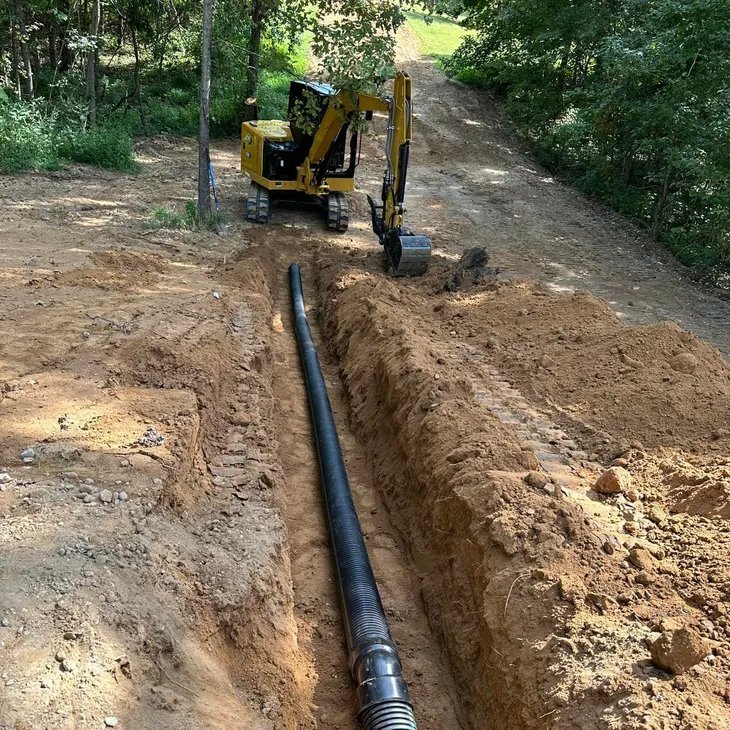
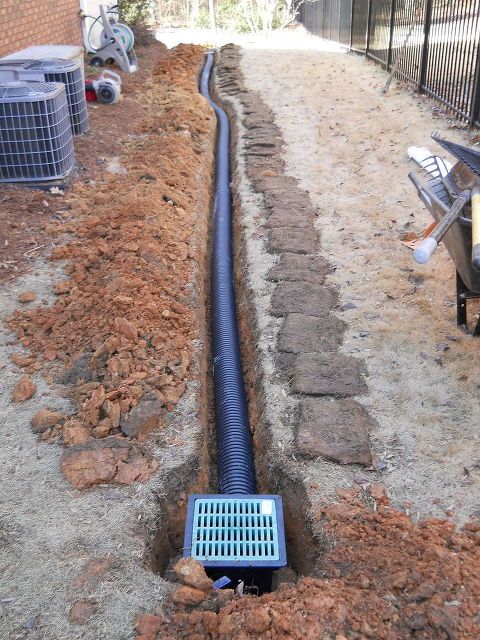
In practice that is a perforated pipe in a gravel trench set above the pan rather than into it, running on consistent fall to a point where it can discharge in the open, usually with a catch basin at the wet spot to take surface water in as well. The pipe does the work. The gravel is just the path water takes to reach the pipe.
What does not work is the version sold most often: a short gravel trench dug in the middle of the wet area with no outlet. In sandy ground that can function as a dry well. Over a fragipan it fills with water during the first heavy rain and stays full, because the bottom of the hole is the same impermeable layer that caused the problem.
3. Roof water
A surprising share of calls that start as a yard drainage problem are a gutter problem. A thousand square feet of roof sheds roughly 600 gallons in an inch of rain, and most of it exits at two or three downspouts. If those discharge at the foundation, you have concentrated a quarter of the roof into a spot the size of a dinner plate.
Check this before you spend anything. Clean the gutters, and extend the downspouts well away from the house, or pipe them underground to the same outlet a yard drain would use. This is the cheapest fix on the list and sometimes it is the whole answer.
4. Compacted subsoil from construction
On a newer subdivision lot, equipment ran over that ground repeatedly while the house went up, and the topsoil that went back down afterward is often a thin skin over compacted silt. Grass roots stay shallow, water does not move down, and the yard behaves like a parking lot with sod on it.
Here the answer is mechanical: break up the compacted layer and reestablish a workable profile. Harley raking and proper soil prep before seed or sod is a different job from installing a pipe, and on the right lot it fixes the problem without one.
5. A drain or culvert that has already failed
If the property has a roadside ditch or an existing pipe, check it before assuming you need something new. Silted culverts are extremely common here, and a pipe that has lost its grade, crushed, or separated at a joint will back water up across the yard behind it.
A dip forming in the driveway over a culvert is its own warning: soil is washing into the pipe through a failure, and the void underneath is bigger than the dip on top. Our write up on driveway culvert installation cost in West Tennessee covers the sizing and the county permit, because around here the county decides the pipe diameter, not the homeowner.
What You Can Do Yourself, and Where It Stops
Plenty of this is genuinely a weekend job, and we would rather tell you that than sell you a trench you did not need.
Worth doing yourself:
- Clean the gutters and extend the downspouts. Start here every time.
- Dig the test hole. Two feet down in the wet spot tells you more than any amount of reading.
- Pull your soil map on Web Soil Survey.
- Clear the inlet of an existing culvert or catch basin if it is simply blocked with leaves and silt.
- Fill and reseed a genuinely small dip, once you know the dip is the cause and not a symptom.
Where it stops being a weekend job:
- Anything that needs an outlet. A drain is only as good as the place it ends. Finding fall across a flat lot, and a legal place to put the water, is most of the skill in this work.
- Anything that has to hold grade over distance. Hand digging a long run on consistent slope through heavy wet silt is brutal, and a run that dips in the middle silts up and quits.
- Anything near a utility. Call 811 before a shovel goes in the ground, every time, including for a shallow drain line.
- Anything involving the roadside ditch or the right of way. That belongs to the county, and working in it without the permit is how people end up paying for the same crossing twice.
- Anything where the water ends up on someone else's property. See below, because this one has teeth.
Where You Are Allowed to Send the Water
This is the part that turns a drainage project into a dispute, and it is almost never mentioned in the national guides.
Tennessee does not let you simply push your problem downhill. The Court of Appeals has stated the rule directly: in cases involving surface water, a property owner creates a nuisance when he wrongfully interferes with the natural flow of water across his land in a manner that causes flooding on adjacent property. The question courts ask is whether you changed the natural drainage pattern in a way that sent water onto the neighbor in unnatural amounts.
Read practically, that means water already flowing toward the back corner can generally keep going that way. Collecting four downspouts and half a back yard into a pipe and aiming the end of it at the fence line is a different thing, and it is the version that gets people sued by someone they have to keep living beside.
So the outlet gets decided first, not last. Usually that is a roadside ditch or storm inlet with the county's blessing, a natural drainageway already crossing the property, or a daylight point on your own ground far enough from the neighbor that it spreads out and soaks in before it gets there. If none of those exist, the honest answer is sometimes that the water has to be managed on the property rather than exported, and the design changes accordingly.
What We Do
Modern Shovel handles drainage installation, grading, erosion control and culvert installation across the Memphis area. We are based in Millington, owned by Austin Scott, fully insured, and we hold a 4.9-star rating across 30+ Google reviews.
Because we also do the dirt work, the gravel and fill and the sod that goes back over the top, a yard drainage job here is one crew from the first cut to the grass growing again, rather than a trench left for somebody else to finish.
On the site visit we will dig in the wet spot and tell you what is under it, and if the answer is that your gutters are the problem and you do not need us, we will tell you that too. That part is free.
Call (901) 479-0236 or request a free estimate. We cover Millington, Memphis, Bartlett, Arlington, Lakeland, Atoka, Munford, Brighton and Covington, and out through Tipton and Fayette County. See the full service area.
Frequently Asked Questions
How long should standing water take to drain from a yard?
Use 24 hours as the dividing line. A puddle that clears within a day of the rain stopping points to a surface problem, usually a low spot or a reversed grade, and grading fixes it. Water that stands for two to four days, or returns without rain, points to water perched on a restrictive layer below the surface. Those two problems need different work, so the timing is worth observing before you get quotes.
Why does my Memphis yard hold water when my neighbor's does not?
Often because you are on different soils. Most upland soils around Shelby and Tipton County formed in loess, and the Loring and Grenada series both have a fragipan, a dense layer roughly 14 to 36 inches down that perches water in late winter and early spring. The Memphis series, common on hillsides in the same neighborhoods, has no fragipan and drains well. Two lots on the same street can sit on different map units. You can check yours free on the USDA Web Soil Survey.
Will a French drain fix standing water in my yard?
Only if it has somewhere to drain to. A perforated pipe in a gravel trench works when it runs on consistent fall to an outlet in the open. A gravel trench dug into the middle of a wet area with no outlet does not work in this soil, because the bottom of that trench is the same fragipan that stopped the water in the first place, so it fills and stays full. Decide where the water is going before deciding what to install.
Can I drain my yard water onto my neighbor's property?
Be careful. Tennessee's Court of Appeals has said that in cases involving surface water, a property owner creates a nuisance when he wrongfully interferes with the natural flow of water across his land in a manner that causes flooding on adjacent property. Water that naturally drains that direction is one thing. Collecting roof water and a whole back yard into a pipe and discharging it at the property line is the version that causes legal trouble, so the outlet should be settled before the trench is dug.
When is the best time of year to fix yard drainage in West Tennessee?
Late summer and early fall. Memphis normals run about 54.94 inches of rain a year, with December through May carrying the heaviest months and September the driest at roughly 3.03 inches. Drier ground means equipment crosses the yard without wrecking it, trenches hold their walls, and the work is finished before the wet season rather than during it. Have the site looked at whenever you notice the problem, then schedule the dig for dry ground.
Yard Holding Water? Let's Find Out Why.
Drainage, grading and culvert work across Millington, Memphis, Tipton County and Fayette County. We dig in the wet spot and tell you what is actually under it before quoting anything. (901) 479-0236
Sources: USDA Natural Resources Conservation Service, National Cooperative Soil Survey, Official Series Descriptions for the Loring series (depth to fragipan 14 to 35 inches; type location Shelby County, Tennessee), the Grenada series (fragipan generally 18 to 36 inches, perching water in late winter and early spring, with an eroded phase as shallow as 12 inches) and the Memphis series (no fragipan), and USDA Web Soil Survey; NOAA National Weather Service Memphis, Memphis normal climate precipitation normals; Whitford v. Village Groomer and Animal Inn, Inc., No. M2020-00946-COA-R3-CV (Tenn. Ct. App. Sept. 17, 2021), on surface water nuisance. Soil map units describe what is typical for an area and not what is under one particular spot, so confirm on site. This article is general information about drainage work and not legal advice.